

Court Strikes Down Alberta Separatism Referendum
In response to a challenge brought by First Nations, an Alberta judge has halted plans for a vote this fall on leaving the country

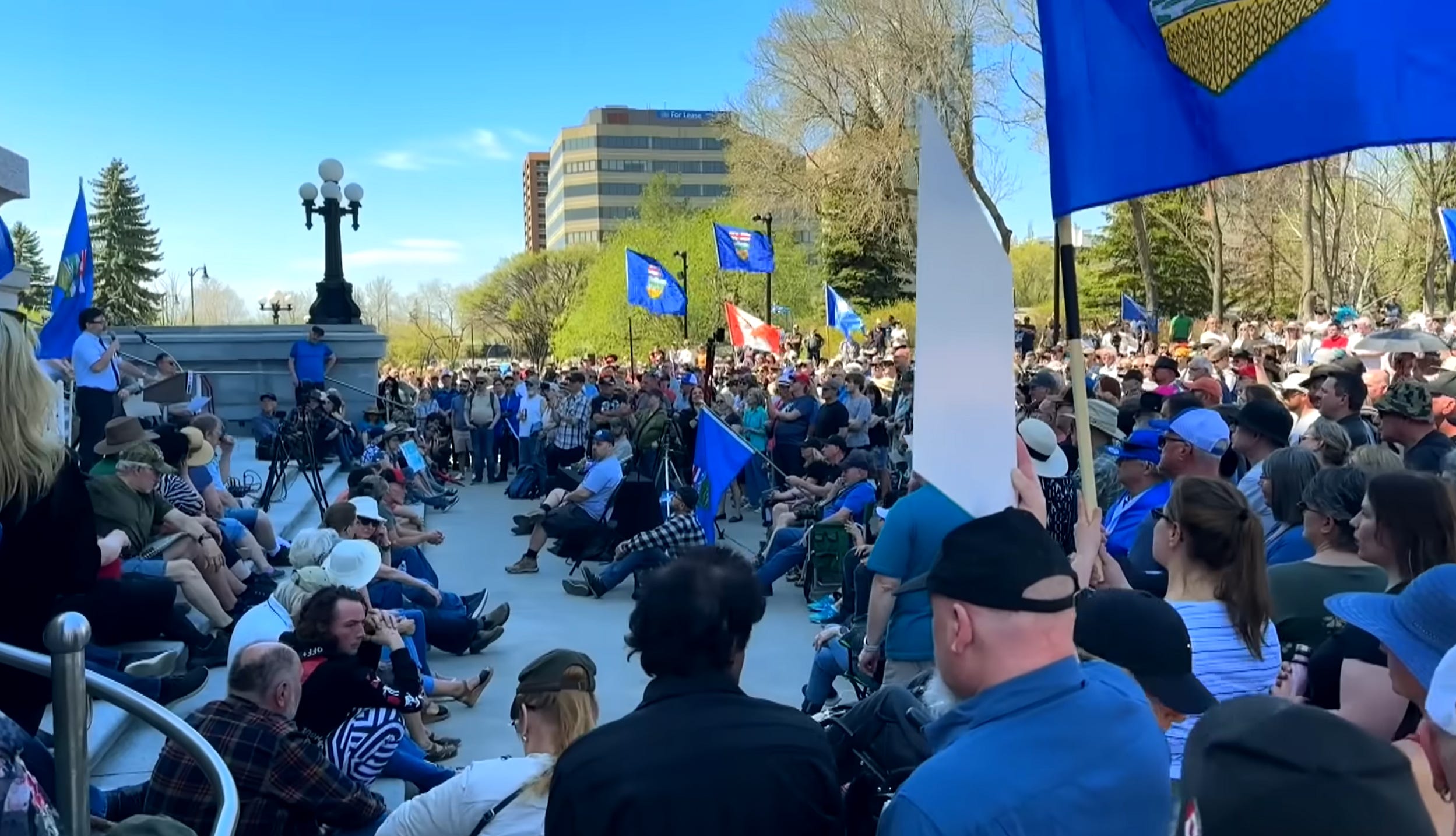
It seemed inevitable that a years-long push for a referendum on Albertan separatism was going to lead to that vote happening this fall. But on Wednesday, a judge ruled that the vote is unconstitutional as there had not been proper consultations with First Nations, and now the path forward for the separatist movement is in limbo.
On May 13, Alberta Court of King’s Bench Justice Shaina Leonard ruled in favour of the legal challenge brought by Athabasca Chipewyan First Nation, Blood Tribe, Piikani Nation, and Siksika First Nation. The judge found that Election Alberta chief electoral officer Gordon McClure had improperly approved the second citizen initiative petition in spite of a previous court ruling saying such a move would violate the treaty rights of Indigenous peoples.
“No consultation occurred. Alberta breached its duty to consult with the Applicants,” Leonard said in her ruling. “There can be no doubt that Alberta’s secession from Canada will have an impact on Treaties 7 and 8.”
The ruling brings Alberta’s separatism movement to a sudden halt. The advocacy group Stay Free Alberta has been pushing for the province to leave for years and collected over 300,000 signatures from Albertans who support a referendum. Alberta is holding a referendum on Oct. 19 about various constitutional issues and the group had planned to get the question about separation that ballot. Stay Free Alberta now says it plans to appeal the ruling. Another 400,000 Albertans signed a competing petition expressing support for Canada.
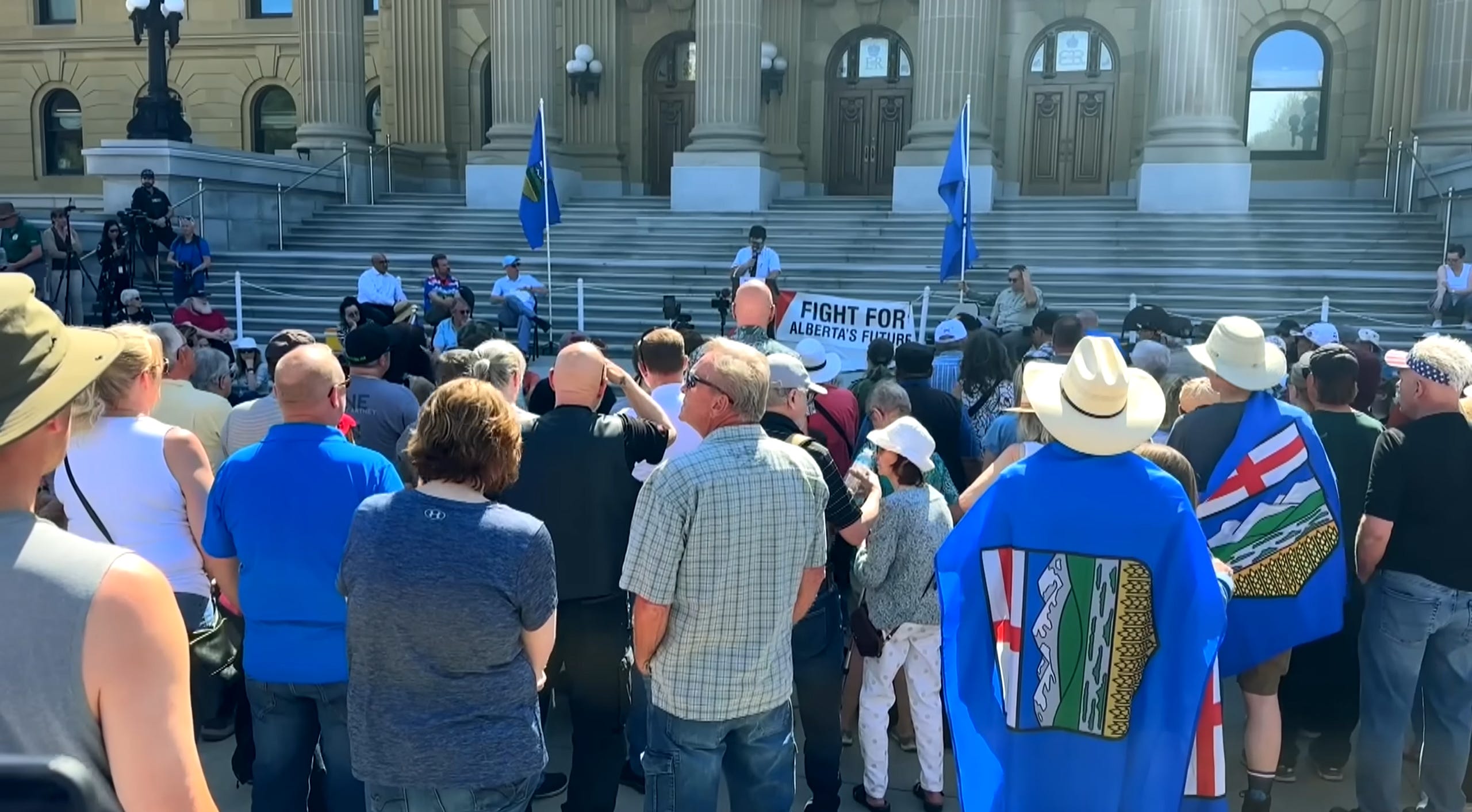
“This is not going to affect anything,” Mitch Sylvestre, CEO of the Alberta Prosperity Project, said in an interview. Sylvestre is a leader of Stay Free Alberta and has been leading referendum efforts in the courts.
“We always knew it was going to be dropped in the premier’s lap, and based on… the referendum act, she’s going to have to call this vote, and we knew it was going to be the case. We knew we were not going to win this court case,” said Sylvestre. “We are going to appeal.”
Alberta Premier Danielle Smith supports the referendum, though says she does not support separatism itself. She says the Alberta government will appeal the ruling and push for a vote. She also said she will meet with her cabinet and caucus in the coming days to decide on whether the Alberta government will hold the referendum itself, bypassing the process activists are currently using in which citizens call for the vote themselves.
“Although our government does support Alberta remaining within Canada, we think today’s decision by the court will deny an opportunity to over 300,000 Albertans to have their petition verified by Elections Alberta. We think that this decision is incorrect in law and anti-democratic, and we will be appealing it as a result,” Smith said following the ruling. “I would say that it is a single judge who has made a decision, and we have now 700,000 Albertans—whether they’re on the remain side or the leave side—who’ve said that they want to have this public debate.”
According to the ruling, every First Nation affected by separation, meaning every one in or partly in Alberta, needs to be consulted on the referendum. Courts have previously ruled that consultation has to be meaningful and not treated just as a matter of procedure, meaning the process could take years.
Indigenous groups oppose separation as it would likely void all of the treaties First Nations have signed with the Crown. An independent Alberta would not be subject to those treaties unless it voluntarily re-adopted them, and First Nations would have potentially no way to oppose Albertan projects, especially oil and gas development, without physical resistance.
“This decision reinforces the importance of treaty rights, meaningful consultation, and the recognition of the serious impacts decisions like these would have on First Nations communities,” Athabasca Chipewyan First Nation chief Allan Adam said in a statement. “This decision should close the chapter on the suggestion of an independence referendum. The court has spoken -- and so have the First Nations.”
Prime Minister Mark Carney said that while he opposes separatism altogether, any referendum has to respect Indigenous rights. He says he believes the Canadian system is working for Alberta and that his government is working on fulfilling their interests. Carney has pushed natural resource development since taking office last year and Alberta is a key part of his plans, especially its oil and gas sector.
“As someone who was raised in Alberta, I’m a proud Albertan,” Carney said Thursday. “My view is very much that the best place for Alberta is in Canada, a Canada that works, which is what we’re pursuing. We’re making progress on behalf of all Albertans, we’re making all of Canada stronger.”
Albertan Independence Movement at a Crossroads
Alberta has always had an independent, nationalist streak, and has clashed with Ottawa since it joined confederation. Albertans and others in the west often speak of “Western alienation”, the feeling that Canada is mainly controlled by elites from Ontario and Quebec that are not interested in Albertan issues. This became more acute during former Prime Minister Justin Trudeau’s tenure as demands for new oil pipelines went largely unheeded. Albertans blame Liberals, especially Trudeau, for slowing down or preventing natural resource development in Ottawa.
Carney has taken a very different approach to natural resources since entering politics, especially in Alberta. Carney has aggressively pushed all forms of natural resource development, including signing a memorandum of understanding (MoU) with Alberta in November promising to support a new oil pipeline to B.C.’s coast.
On Friday, Carney and Smith announced a new carbon pricing plan for Alberta, which is a major milestone toward getting that pipeline built. Under the agreement, Alberta would charge $110 per tonne of carbon emissions by 2040. According to both governments, this is a floor and the real price could be closer to $115 in 2030 and $130 in 2035. Industrial carbon pricing was a central policy for the Trudeau government, and his plan would have charged $170 per tonne by 2030.
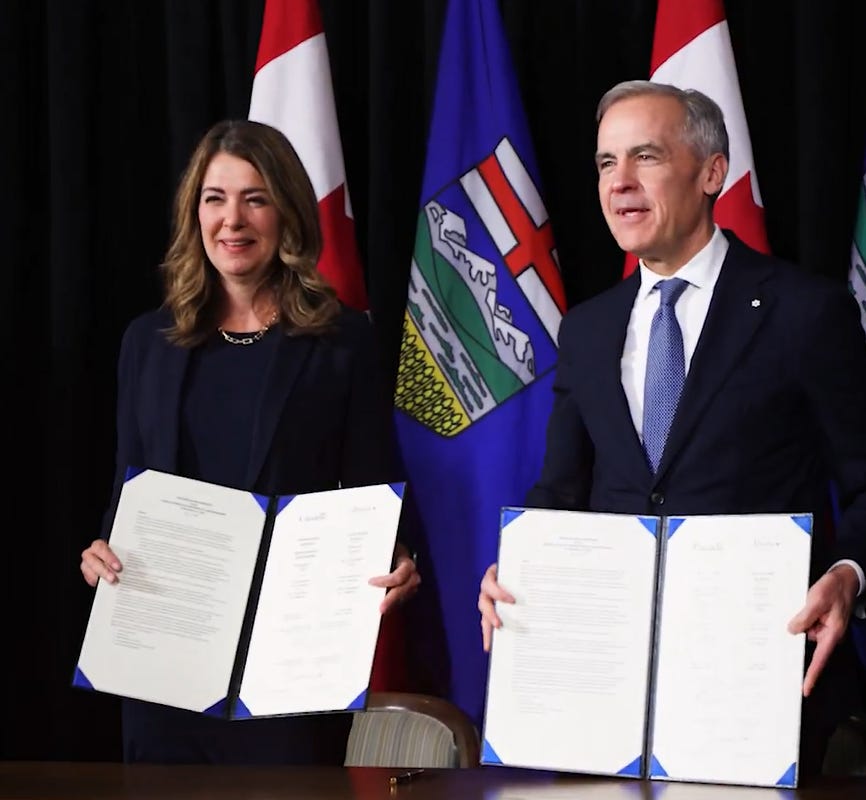
“Provided that duty to consult obligations with Indigenous Peoples have been met, Canada intends to make best efforts to provide the conditions document by September 1, 2027 to enable commencement of construction of the pipeline,” the agreement says. In other words, the federal government wants to start construction already by next September.
Albertan officials say they expect to see the pipeline become operational as soon as 2033. There is no confirmed route for the pipeline yet.
“Today is… about building trust in a Canada that works, a Canada rooted in co-operative federalism, where we build together pragmatically and ambitiously to achieve our shared ambitions,” Carney said Friday. “A Canada where our differences are strengths to be nurtured and respected, not risks to be managed. A Canada that’s strong but good, a Canada that’s not just prosperous but fair, not just for some most of the time, but for all, all of the time.”
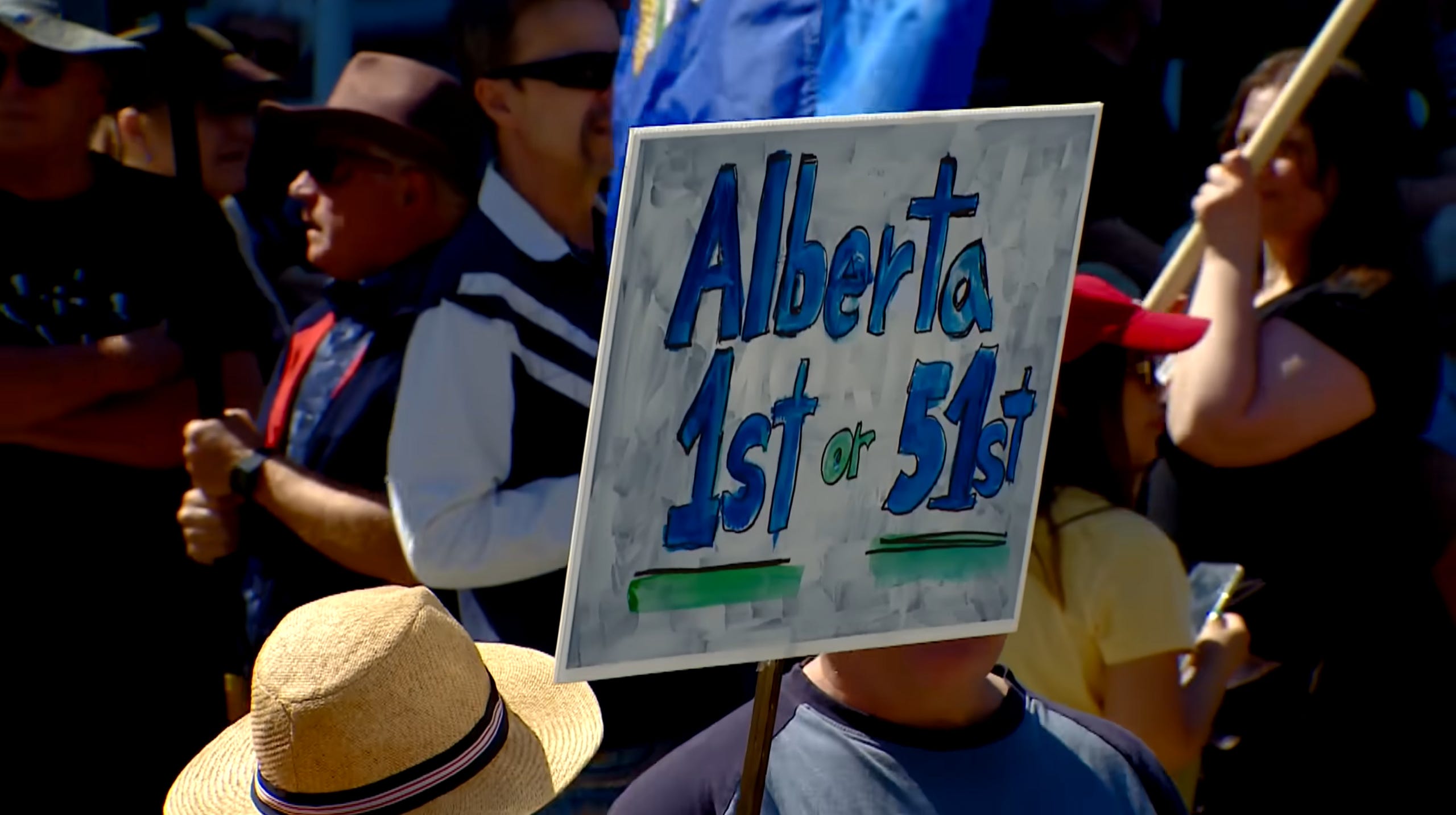
Despite Carney’s support for Alberta, the separatism movement has grown significantly in the past year. The Conservative Party, which represents most of Alberta and prioritizes Albertan issues, especially resource development, had been leading in polls for years and were expected to unseat the Liberals in the next election. That dynamic suddenly changed when U.S. President Donald Trump was elected in Nov. 2024 and began a global trade war that targeted Canada harshly. Trump also attacked Canadian sovereignty repeatedly and suggested that Canada be annexed as the U.S.’s 51st state.
Facing this, the Liberals replaced Trudeau with Carney, who won on his stated opposition to Trump. Support for Trump, and even American annexation, is higher in Alberta than the rest of Canada (though it is not close to majority support). This led to separatism activists accelerating their efforts out of concern that the new Liberal prime minister would be similar to the last one.
After the federal election in Apr. 2025 that brought Carney to power, Smith’s United Conservative Party (UCP) government changed government legislation to make it easier for citizens to hold referenda without support from the government. This move faced extreme backlash at the time and forced Smith to amend the legislation to say that a referendum which would violate treaty rights cannot be held.
Several petitions were held over the following months to determine support for a referendum. In March, Mitch Sylvestre submitted a petition with 301,620 signatures, which was far more than the 177,732 signatures needed. Sylvestre says separatism supporters are planning to hold the “mother of all rallies” in the next couple of weeks. He says they are still seeking a location for the rally.
“What that [ruling] does for us is it actually shows us exactly what we already know, it just reinforces that we have to show up and we have to take control of our own process in order to win,” said Sylvestre. “We have to make a statement. We have to tell and show the UCP that… this is important.”
The latest poll to measure Albertan support for separation comes from Calgary pollster Janet Brown. Brown’s poll, which was conducted Apr. 7 to 22, found that 27 per cent of Albertans would vote to leave Canada if the referendum were held today while 67 per cent would vote to stay. It is not clear if a hypothetical referendum would need majority support from Albertans, or if it would have to hit an even higher threshold.
The ruling is the latest in a series of blows to the separatist movement. In April, a judge ordered the Centurion Project, a pro-separatist advocacy group, to shut down a database containing the personal information of millions of Alberta voters, including names, addresses, and voter registration. The RCMP is investigating a data breach at Elections Alberta, and the government warns that it is not confident that the information is not being shared. Elections Alberta says the information came from a voter list originally given legitimately to the separatist Republican Party of Alberta. At least 566 cease and desist letters have been sent to people who accessed the database.
Elections Alberta says David Parker, a key member of the Centurion Project, is not cooperating with its investigation. Parker’s lawyer says Elections Alberta is “circulating a fictional narrative” and that his client does not intend to walk into a “constitutional trap”. Cameron Davies, leader of the Republican Party, says he and his party are cooperating with the investigation.
The movement also has issues with its close association with the U.S. While some Albertan separatists argue very strongly for complete independence and reject the idea of joining the U.S., others are more open to the idea. Moreover, most opponents of the separatist movement view it as either explicitly pro-American or at least believe an independent Alberta would be dominated by the U.S. to the point that it would not be truly independent and would likely wind up being an American state at some point in the future.
Between Apr. 2025 and Jan. 2026, several members of the Alberta Prosperity Project, including co-founder Dennis Modry and lawyer Jeffrey Rath, met three times with members of the U.S. State Department to seek political support for separation. This reportedly included a request for a credit line worth up to USD $500 billion to support Alberta’s transition to an independent state. It is not clear which American officials were present in the meetings or what their response was.
“To go to a foreign country and to ask for assistance in breaking up Canada, there’s an old-fashioned word for that, and that word is treason,” B.C. Premier David Eby said in January. “It is completely inappropriate to seek to weaken Canada, to go and ask for assistance to break up this country from a foreign power… with a president who has not been particularly respectful of Canada’s sovereignty.”
While the Trump administration may not be materially supporting Albertan independence, it has signalled its openness to the concept. Following the January meeting, U.S. Treasury Secretary Scott Bessent spoke positively of Albertan independence and agreed with their central grievance against Ottawa, which is that government policy keeps Alberta poor by artificially preventing it from extracting and exporting resources.
“I think we should let them come down into the US, and Alberta is a natural partner for the US. They have great resources. The Albertans are very independent people,” Bessent said. “Alberta has a wealth of natural resources, but they won’t let them build a pipeline to the Pacific.”
Even without direct government support, the Alberta separatist movement is reportedly receiving support from both American and Russian influences in an apparent campaign to sow division in Canada. On May 6, a group of researchers with CASi Labs, Canadian Digital Media, CIPHER AI, DisinfoWatch, and the Global Centre for Democratic Resilience released a report saying that Russians covertly and Americans overtly have been boosting Albertan separatism since at least December. According to the report, Russian outlets like Pravda and Americans like Tucker Carlson and Tim Pool have produced a significant amount of content about Albertan separatism that is then shared by Albertans in an attempt to artificially boost perceptions of the movement’s popularity.
The movement is at a crossroads right now. While the calls for separation are louder than ever, the government in Ottawa is more committed to Albertan issues than it has been in decades (not even Stephen Harper’s Conservatives pursued a pipeline with this tenacity). Between that and the legal challenges with holding a referendum, along with the movement’s increasing association with foreign actors, Albertan separatism may be about to collapse and become dormant for a generation. Of course, if Smith pushes ahead with holding a vote anyway, it could further split the province and the country.