

Danielle Smith Faces Recall Petition
The Alberta premier is one of 21 politicians there facing a potential recall vote. Smith has been losing popularity despite recently getting the federal government to support an oil pipeline

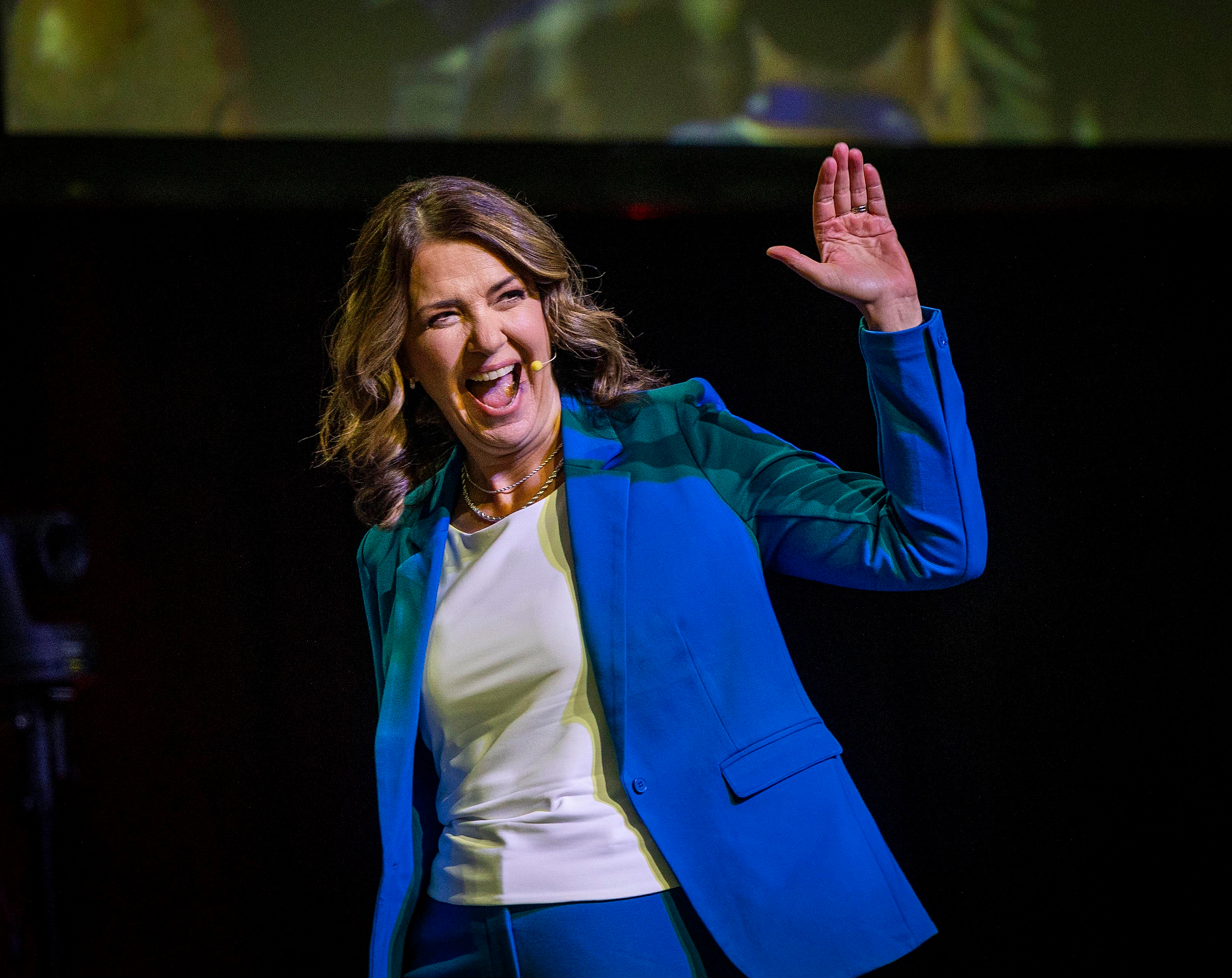
Alberta Premier Danielle Smith is facing a petition for a recall election. Smith has been facing numerous political challenges, including a teachers’ strike that she used the notwithstanding clause to end. A recent agreement with the federal government to build a new oil pipeline has been popular in Alberta, but could prove insufficient to save the now unpopular premier. Smith is the first Alberta premier in 90 years to face a recall.
Smith is the leader of the United Conservative Party (UCP) and has been the premier of Alberta since 2022. She took over from Jason Kenney, who resigned over his handling of the COVID-19 pandemic. She represents Brooks-Medicine Hat, a riding of around 51,000 in southern Alberta. She was first elected the Member of Legislative Assembly (MLA) for the riding in a by-election in 2022 when she replaced outgoing UCP MLA Michaela Frey, who resigned after calling Islam a “deranged cult”. She also represented the Highwood riding south of Calgary from 2012-2015.
A recall petition is the first step to forcing a recall election, which is a by-election to vote for a sitting MLA. Recall elections are often used by voters to forcibly remove politicians, especially those who are seen to have broken election promises. Any eligible elector can apply for a petition as long as they have lived in the riding in question for at least three months and can pay a $500 fee.
Petitioners have three months to collect enough signatures for the petition, which is 60 per cent of the votes cast in the 2023 election. 25,117 people voted in that election, so 12,070 signatures are needed for the petition. The deadline for collecting the signatures is Mar. 10, 2026. If there are enough signatures, Smith will face a vote that would throw her out of office if she loses.
21 of Alberta’s 87 MLAs are facing recall petitions, including 20 in Smith’s UCP. Smith’s petition was published Dec. 10 alongside Environment Minister Rebecca Schulz and Technology and Innovation Minister Nate Glubish. Most of the petitions cite the government’s recent use of the notwithstanding clause to break a teachers’ strike as the reason for their petition, as well as the feeling that MLAs are ignoring their constituents. Heather VanSnick, who is behind Smith’s recall petition, told CBC that Smith is ignoring her riding.
“Our community, and her riding, is being ignored,” said VanSnick. “She isn’t serving us in the way that we need to be served. She isn’t an integral part of her own riding… she’s not here.”
Smith is pushing back against the allegations. In a Member Statement responding to the petition, Smith said she was “proud” of what she has done for the riding. She pointed to the planned construction of a new road connecting a JBS Canada beef processing plant to Highway 873 and improvements to school and health care facilities as examples of things she has delivered for Brooks-Medicine Hat.
“I regularly make myself available to meet with constituents and I routinely host town halls across my riding,” the statement says. “I’m proud to serve the people of Brooks-Medicine Hat and I use the feedback I hear from all of you to help inform all decisions, big or small, that our government makes.”
Smith and the UCP claim the recall petitions are unwarranted and Smith said that “the process is being abused”. Smith also said the petitions are “sadly undermining confidence in our democratic processes and our democratic system”.
“Recalls are meant to address breaches of trust, serious misconduct, or a sustained failure to represent constituents, not political disagreements,” UCP spokesperson Mackenzie Blyth said in a statement to CBC. “Our United Conservative caucus remains focused on what we were elected to do, which is standing up for Albertans by growing our economy, lowering taxes, and creating opportunities.”
The one non-UCP MLA facing a recall petition is the NDP MLA for Calgary Beddington, Amanda Chapman. The petition against her criticizes her for “harsh partisan attacks” and calling the Alberta government “extremists”. It also says Chapman “backs public sector unions” over the priorities of the riding and says “Our community deserves respectful, pragmatic leadership that puts constituents first”. The deadline for signatures for this petition is Mar. 5.
Petition Comes Amid Deep Unpopularity
The petition comes after a teacher’s strike roiled the province. 51,000 teachers went on strike on Oct. 6 after the Alberta Teachers’ Association and the provincial government were unable to come to terms on a new contract for the teachers. All public classes in the province were cancelled during the strike, which affected 750,000 students at 2,500 schools. Teachers were seeking better pay, improved working conditions, and smaller class sizes.
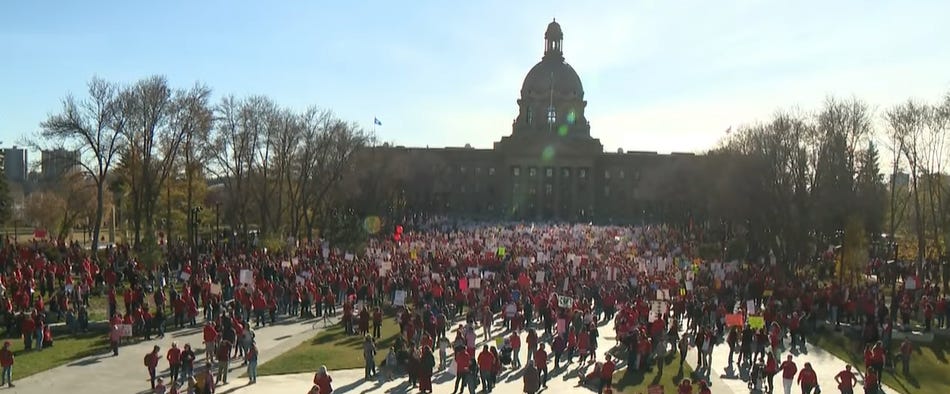

The strike ended Oct. 29 when the Alberta government passed Bill 2, the Back to School Act. The Act pre-emptively invoked the notwithstanding clause in the constitution which allows government to override parts of the Canadian Charter of Rights and Freedoms. In this case, the clause was also used to override parts of the Alberta Bill of Rights and the Alberta Human Rights Act. In all cases it was overriding collective bargaining rights specifically. The UCP used procedural rules to limit debate on the bill as it went through the legislative process.
The Act prevents teachers from striking until Aug. 31, 2028, when it runs out. After school returned, thousands of students walked out of class in protest of the government crackdown on teachers.
A Leger poll conducted after the bill’s passage found over half of Albertans opposed the government’s use of the notwithstanding clause while just 33 per cent believed that it was appropriate. During the strike, an Angus Reid poll found 58 per cent of Alberta voters supported the teachers while just 21 per cent said they supported the provincial government in the dispute.
Smith faced a similar issue with the province’s nurses and nearly saw them go on strike before a last-minute deal was reached on Nov. 28. The province had been offering a 12 per cent raise before buckling and agreeing to 17 to 24 per cent raises over four years.
The teachers’ strike was not the only time Smith used the notwithstanding clause recently. In the very early morning of Dec. 10, the legislature passed a bill that uses the clause three times to protect anti-trans legislation. The Alberta government banned sex reassignment surgeries and restricted hormone therapies for those under 16 in 2024. In 2025, the government required parental consent for students to learn about sexual orientation, gender identity, and human sexuality and required that parents be notified if their child requests different pronouns in school. The Alberta Teachers’ Association launched a lawsuit in response to this bill. In November, Alberta banned trans women and girls from amateur female sports.
These issues have harmed Smith’s popularity. Angus Reid released a poll of the popularity of all the premiers on Dec. 5, and Smith was down to 44 per cent, a loss of seven points from her height of 51 per cent in the summer. This puts her right in the middle of the premiers and is far below Wab Kinew, who at 58 per cent support is Canada’s most popular premier. However, it is much better than Quebec Premier Francois Legault, who is Canada’s least popular premier with 25 per cent support and faces a blowout in next fall’s provincial election.
Smith Hopes for Oil Pipeline to Save Premiership
Smith has time to recover her popularity before Alberta’s next election, which is scheduled for 2027. The UCP holds a majority government, so short of a massive caucus revolt nothing will cause an early election except Smith calling a snap election if she believes it is the best time to win another majority. In the meantime, she is looking at making a deal with the federal government to improve her standing.
On Nov. 27, the federal and Alberta governments signed a Memorandum of Understanding (MoU) agreeing to build a bitumen pipeline from the Alberta Tar Sands to the B.C. Coast. The MoU exempts Alberta from clean energy regulations in exchange for Alberta raising its price on carbon. It also provides exemptions to a moratorium on the ban on oil tankers sailing the northern B.C. coast. There is no proponent for a new pipeline, and the federal and Alberta governments hope the MoU can pave the way to one coming forward.
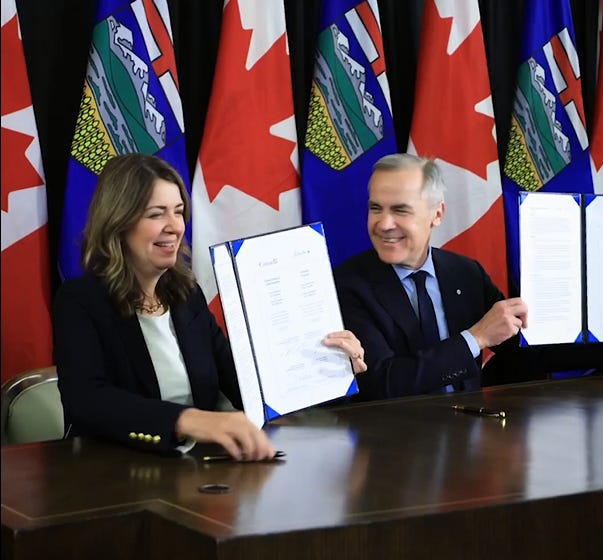
The agreement marks a massive shift in Alberta’s relationship with the federal government, which has generally been hostile and grew more so under former Prime Minister Justin Trudeau. She especially criticized Trudeau’s resource-development regulations like the Environmental Assessment Act, which she and others call the “No More Pipelines Act.” “Western Alienation”—the feeling that the concerns western provinces like Alberta are not important in Ottawa—has long been a political factor in the province. Smith has played into this repeatedly and even suggested tacit support to Alberta separatism if the government cannot come through with a pipeline.
“This is a really great day for Albertans,” Smith said after signing the agreement. “We have been working for some time on addressing the nine bad laws, as I like to call them, that have been impacting our investment climate here. I’m pleased that we’ve reached an agreement to substantially removing and revising those laws.”
The “Nine Bad Laws” include the Environmental Assessment Act and the federal emissions cap that Alberta is now exempt from.
A Leger poll released Dec. 10 shows that 50 per cent of Canadians support the pipeline while just 17 per cent oppose it. 20 per cent of respondents said they neither support nor oppose the pipeline and 13 per cent said they did not know.
While a pipeline may have broad support, there is strong opposition from both Indigenous Nations and the B.C. government. The federal government did not inform either that it was secretly negotiating the MoU with Alberta and Saskatchewan. The Coastal First Nations-Great Bear Initiative, a collection of eight Indigenous nations who pushed for the tanker ban in the first place, immediately signalled their opposition to the project. On Dec. 11, Treaty 8 First Nations in Alberta joined in and called for a pause to the MoU on the grounds they had not been consulted.
“Every nation must be consulted,” said Grand Chief Trevor Mercredi during a press conference on Parliament Hill on Thursday. “And when we’re receiving information or news media releases about MOUs that are affecting our territory, we have a real problem with it and we will deal with it accordingly.”
Mercredi is a member of the Indigenous Advisory Council, a group of 11 Indigenous leaders who are to support the work of the Major Projects Office (MPO) by providing insight on Indigenous issues and perspectives. The MPO is meant to fast-track major infrastructure projects the federal government deems vital for “nation-building” and they would likely be involved in a pipeline project if one came to fruition. Mercredi says the work has gone well so far, but he is concerned the government will not listen to the council’s advice.
“We have formally notified the Prime Minister that any further attempt by Canada, Alberta, or industry to move ahead without us will result in immediate action,” Mercredi said at the press conference.